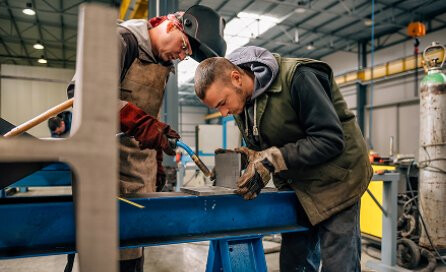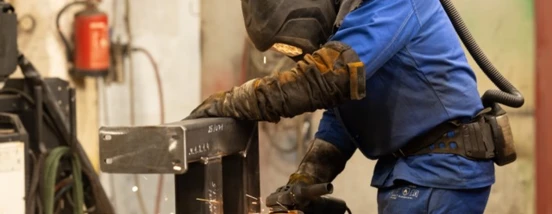
The technical labor market in Europe has been operating under conditions of persistent imbalance for several years. The shortage of welders, fitters, CNC operators, and other production specialists is neither temporary nor local. It affects both Western European countries and Central and Eastern European markets, including Poland.
At the same time, the nature of professional mobility among technical workers is changing. We are increasingly moving away from the model of classic labor migration toward project-based, rotational, or temporary work carried out across different countries and organizational systems. This article presents the current picture of the technical labor market in Poland, Germany, and Norway, based on industry data, institutional reports, and market observations from 2024–2025.
Europe as a Market of Structural Shortage of Technical Personnel
Across the European Union, a persistent deficit of qualified technical workers is clearly visible. This results from several overlapping factors: aging societies, limited inflow of young people into technical professions, and the growing complexity of production processes.
Reports from European and national institutions indicate that professions such as welder, steel structure fitter, CNC machine operator, or industrial mechanic belong to the group of shortage occupations in most EU countries. This deficit is structural in nature—even temporary economic slowdowns do not eliminate demand for experienced technical personnel.
In practice, this means that manufacturing and project-based companies increasingly compete not only on pay rates, but also on work organization, project stability, and the quality of cooperation.
Migration of Technical Workers – A Shift in the Model
The migration of technical workers in Europe has undergone a significant transformation. A decade or so ago, the dominant model involved long-term relocation to a single country. Today, project-based mobility is becoming increasingly common, based on rotations, fixed-term contracts, or work tied to specific investments.
Polish technical specialists now work across multiple markets, changing locations depending on the project, industry, and organizational conditions. Key factors include not only pay, but also schedule predictability, travel logistics, accommodation, and continuity of assignments.
For many technical workers, it is important that working abroad is part of a planned career path rather than a one-off episode.
Poland – A Production Market Under External Pressure
In recent years, the Polish technical labor market has undergone noticeable changes. Wages in technical professions have increased, and the gap between Poland and some Western markets has narrowed. Nevertheless, migration pressure remains, particularly among the most experienced specialists.
In Poland, the dominant model is permanent production work, often in shift systems. For many workers, stability of employment, shorter commute times, and the ability to balance work and private life remain key advantages. At the same time, foreign projects are often seen as an opportunity to temporarily increase income or gain experience with different technologies.
Increasingly, specialists are also returning to Poland after several years abroad, especially when domestic projects offer comparable organizational conditions.
Germany – A Large Market with Significant Diversity
Germany remains one of the main destinations for Polish technical workers, but it is far from a homogeneous market. Working conditions, pay levels, and employment models vary significantly depending on the region, industry, and form of cooperation.
In practice, an important distinction exists between rates declared in job offers and actual net income after accounting for living costs, accommodation, and taxes. Work organization on site is also gaining importance: availability of materials, quality of technical supervision, and real alignment between the scope of duties and the project description.
For many specialists, Germany is attractive due to project stability, but it also requires a high level of independence and work discipline.
Norway – High Rates and a High Entry Threshold
Norway is widely regarded as one of the most financially attractive markets, particularly in offshore, energy, and heavy industry sectors. At the same time, it is a market with very high formal and organizational requirements.
The Norwegian work model often relies on rotations (e.g. 2/3, 2/4), which are not a benefit but a standard resulting from the nature of projects. Certifications, experience in international teams, and the ability to operate within strict health, safety, and quality procedures are critical.
Norway attracts specialists who are fully aware of working conditions and prepared for long-term project engagement rather than short-term earnings-driven assignments.
What Really Determines Market Choice for Technical Specialists
Market analysis shows that while pay rates are the initial reference point, decisions about long-term cooperation are based on a broader set of factors. Technical workers pay close attention to project predictability, the reliability of information provided before work begins, and the quality of on-site organization.
Equally important is the opportunity to genuinely use one’s skills. Projects where responsibilities differ from what was declared, or where technical preparation is lacking, are often evaluated negatively regardless of pay levels.
In practice, the market increasingly rewards experience, independence, and the ability to adapt to different production environments.
Summary
The European technical labor market remains characterized by strong demand for experienced professionals. Poland, Germany, and Norway represent different organizational models and levels of requirements, but they share one common feature: a persistent shortage of qualified specialists.
For technical workers, this means growing mobility and a wider range of career paths. For companies, it means a growing need to better understand production realities, project conditions, and market expectations. In the coming years, operational experience and the quality of work organization will be key factors shaping long-term cooperation stability in the technical sector.
Sources and Industry Materials
Eurostat – Labour market and labour mobility in the EU
https://ec.europa.eu/eurostat/web/labour-market/overview
European Labour Authority (ELA) – Cross-border labour mobility
OECD – International Migration and Labour Market Analysis
https://www.oecd.org/migration/
Statistics Poland (GUS) – Labour market and international migration
https://stat.gov.pl/obszary-tematyczne/rynek-pracy/
https://stat.gov.pl/obszary-tematyczne/ludnosc/migracje-zagraniczne-ludnosci/
Polish Agency for Enterprise Development (PARP) – Labour market and skills
https://www.parp.gov.pl/component/publications
Barometr Zawodów – Occupational shortage forecast in Poland
Federal Employment Agency (Germany) – Labour market and shortage occupations
https://www.arbeitsagentur.de/en
Make it in Germany – Official information portal for skilled workers
https://www.make-it-in-germany.com
NAV – Norwegian Labour and Welfare Administration
Statistics Norway (SSB) – Employment and wages statistics
Norwegian Petroleum Directorate – Offshore and energy sector data
https://www.norskpetroleum.no/en/
ManpowerGroup – Talent shortage and workforce trends
https://www.manpowergroup.com/workforce-insights
Hays – Salary and labour market reports
https://www.hays.pl/raport-placowy
EURES – European Job Mobility Portal
Offshore Energy – Industry news and market developments